Many individuals and families are looking for meaningful ways to help children and grandchildren prepare for future educational expenses. One option that offers both flexibility and tax advantages is a 529 Plan.
What is a 529 Plan?
A 529 Plan is a tax-advantaged savings plan designed to encourage saving for future education costs. These plans may be used for a variety of qualified educational expenses and can play an important role in long-term financial and estate planning.
Benefits of a 529 Plan
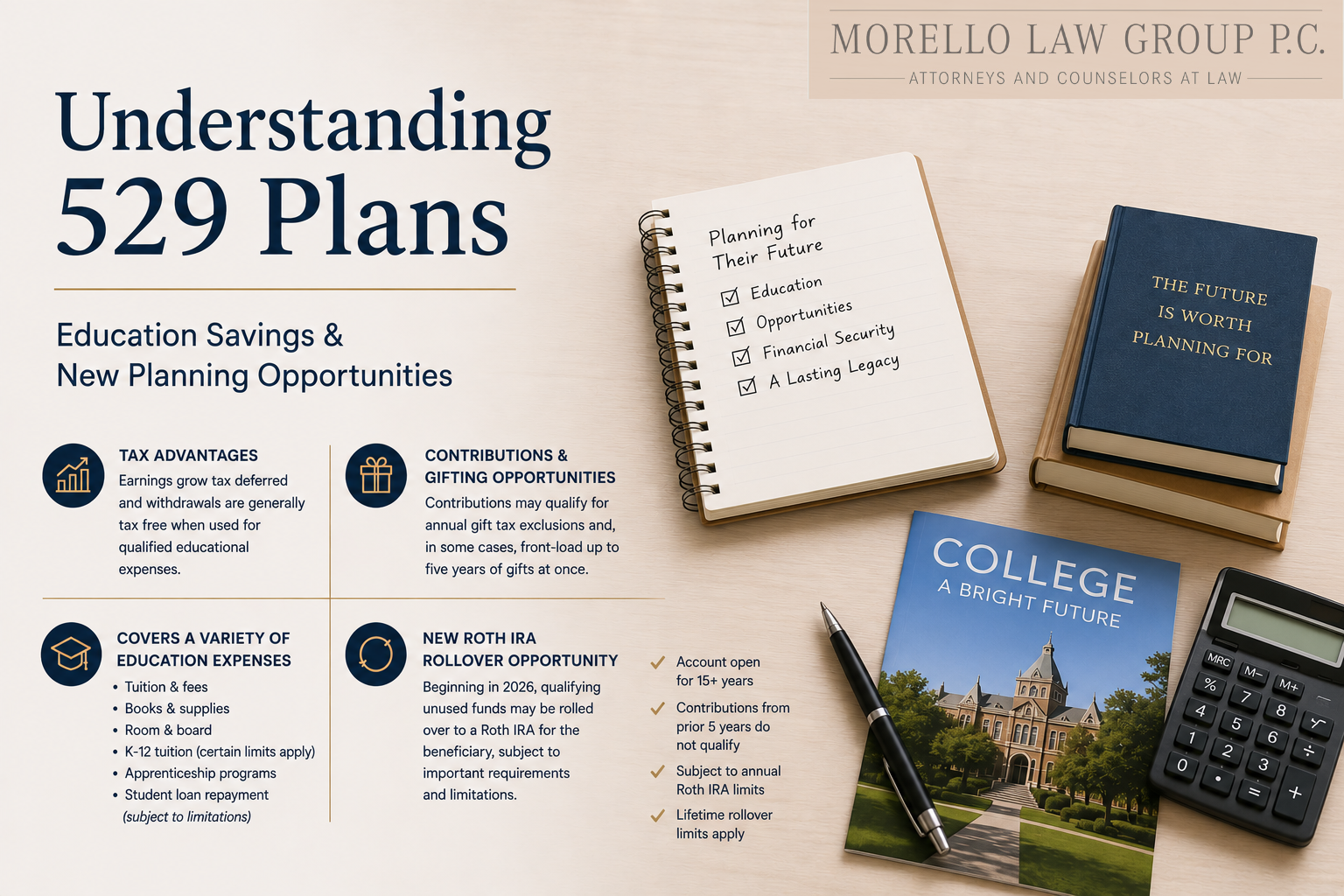
One of the primary benefits of a 529 Plan is that earnings grow tax deferred, and withdrawals are generally tax free when used for qualified educational expenses.
Qualified educational expenses may include:
- College tuition and fees
- Books and required supplies
- Room and board for eligible students
- Certain K-12 tuition expenses
- Registered apprenticeship program expenses
- Student loan repayment, subject to applicable limitations
Contributions to a Michigan Education Savings Program (MESP) may be deductible from Michigan adjusted gross income, up to $5,000 per year for single filers and $10,000 per year for married couples filing jointly.
Additionally, if one beneficiary does not use all of the funds, account owners may have the ability to change the beneficiary to another qualifying family member, without incurring taxes or penalties. Qualifying family members include siblings, children, nieces/nephews, cousins, and certain in-laws.
Custodian and Estate Considerations
The custodian (or account owner) controls the 529 plan, including how and when the funds are used. It is also important to name a successor custodian, which ensures that the 529 plan continues seamlessly if the account owner dies or becomes incapacitated. The successor custodian is typically a parent, grandparent, or other trusted family member.
Contributions are generally excluded from your taxable estate for federal estate tax purposes. However, If the account owner retains certain powers, such as the ability to revoke contributions, change the beneficiary to a non-family member, or withdraw funds for non-qualified purposes, the account could be included in the account owner’s taxable estate.
Contribution and Gift Tax Considerations
Contributions to a 529 Plan may qualify for the annual federal gift tax exclusion.
Under current rules, individuals may contribute up to an aggregate balance of $500,00 per beneficiary. In the case of exceeding the annual limit, $19,000 for single filers or $38,000 for married couples filing jointly, you must file a gift tax return (IRS Form 709). Also, under the federal five-year gift-tax averaging rule, individuals may front-load larger contributions of up to $95,000 (single) or $190,000 (married filing jointly) by electing to treat the gift as being made evenly over five years, to remain within exclusion limits.
For family members looking to help fund education while considering broader estate planning goals, this can be a valuable strategy.
New Roth IRA Rollover Opportunities
Recent law changes have added additional flexibility for certain unused 529 Plan funds.
Beginning in 2026, qualifying unused funds from a 529 Plan may be eligible to be rolled over into a Roth IRA for the same beneficiary, subject to several important limitations.
Some of the current rules for the rollover:
- The 529 account must have been maintained for at least 15 years
- Contributions and earnings from the prior five years may not qualify
- Rollovers remain subject to annual Roth IRA contribution limits – which are $7,500, or $8,600 for individuals age 50 or older
- Lifetime maximum that may be rolled over is $35,000 per beneficiary
- Roth IRA income limits are waived for 529 Plan rollovers
These changes may help ease concerns families have about “overfunding” a 529 Plan while still encouraging long-term education planning.
Is a 529 Plan Right for Your Family?
529 Plans can be a powerful tool for families looking to save for future education expenses while maintaining flexibility for changing circumstances.
As with any planning strategy, every family’s goals and financial situation are different. Understanding how a 529 Plan fits within your broader estate and financial planning goals is important.
If you have questions about 529 Plans or education planning strategies, please contact our office.